Define the outcome before the list
Write down what “ready for now” means for this project. It might be a car that can move under its own power, a tidy rolling shell, or a clear inspection plan. A concrete outcome gives the crew a way to choose between competing jobs.
- Describe the next useful state in one sentence.
- Record what is deliberately out of scope for this stage.
- Name the constraint that matters most, such as space, time or parts availability.
Capture the starting point
Add the car to the garage with the details the group will need to recognise it, such as its name, condition and available vehicle fields. Put project context and open questions in the descriptions or checklists of the first tasks, so a friend joining later has a useful orientation.
- Use a clear project name and the vehicle details.
- Note known open questions instead of guessing an answer.
- Keep ownership for attribution while leaving project work collaborative.
Break the outcome into stages
Use the project’s existing stages — Planning, Mechanical, Bodywork, Interior and Ready — to show where the car is in the broad flow. Put the finer checkpoint and session outcome in tasks rather than inventing a new stage name.
- Select the existing stage that best matches the current work.
- Put the next checkpoint in a task title, description or checklist.
- Move to another existing stage when the agreed project point is reached.
Choose the next garage session
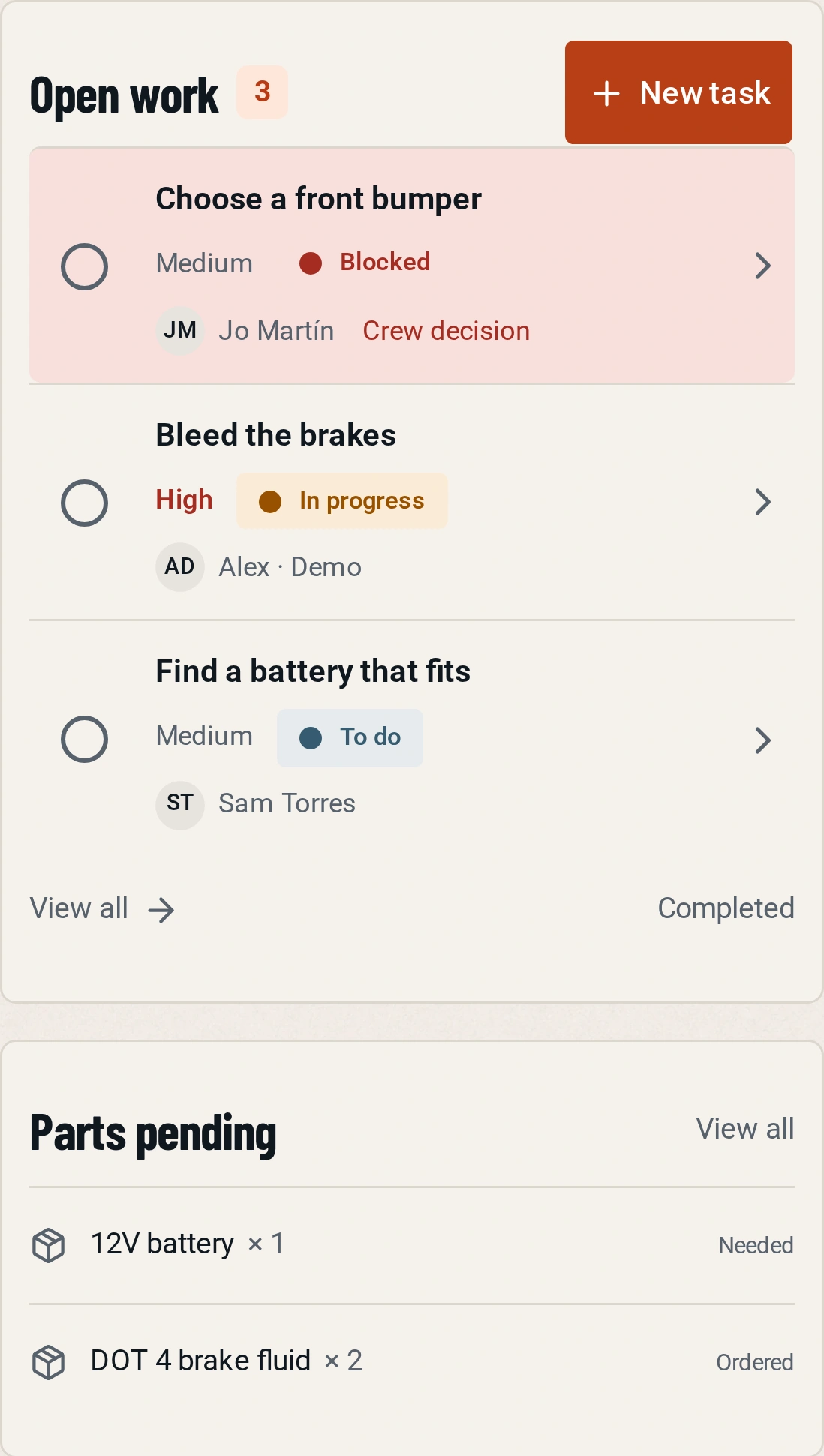
Start with a small set of tasks that moves the current stage forward. The task board makes unfinished, active and blocked work visible so the crew can decide what is worth doing together next.
- Pick one outcome for the session.
- Include the checks or preparation needed before the main job.
- Leave a clear note when a decision needs the group’s input.
Keep the plan honest between visits
A plan should make the next conversation easier, not become another job to maintain. Close finished tasks, leave blocked work visible and update the project when the crew agrees that the stage has changed.
Illustrative example: a Saturday plan
For example, while a car is in the Mechanical stage, a crew could make the task outcome “ready for inspection”, then create one task to gather the open questions, one to check which parts are needed and one to review the list together. These are coordination examples, not a record of a real garage.